News analysis ·
Stratum V1 hashrate hijacking: why Stratum V2 matters
Braiins says attackers used BGP routing to steal hashrate from Stratum V1 miners. We explain the protocol flaw and how Stratum V2 closes it.
Mining software company Braiins has warned that an attacker is quietly stealing hashrate from Bitcoin miners by impersonating their pool, according to Decrypt. No miner and no pool server was breached. This article looks at why the old Stratum V1 protocol makes that possible, and what the encrypted Stratum V2 protocol changes.
The change in one paragraph
Braiins said that on Nov. 20 one attacker redirected the connections of more than a thousand mining sites within a single second, sending their work to an impostor pool. Decrypt reported that this is the second such warning in a matter of weeks: Luxor said last week that hackers had redirected miner rewards, and it linked those incidents to AI-assisted attacks. The common thread is not a bug in a miner or a pool. It is a design gap in the protocol that connects the two, combined with a weakness in how the internet routes traffic.
Under the hood: how Stratum V1 trusts the network
Stratum is the protocol a mining machine uses to talk to its pool. The pool sends a job, which is a template of block data to hash. The machine sends back shares, which are proofs that it did the work. The pool credits shares to an account and pays out from there.
Stratum V1 sends all of this as unencrypted plain text. More importantly, it gives the miner no way to check that the server answering is the genuine pool. The miner trusts whatever machine sits at the address it dialed. That is the gap the attacker used, and it combines with a second trust problem one layer down:
- Border Gateway Protocol (BGP) is the system networks use to tell each other which addresses they can reach. It largely works on trust.
- The attacker announced a narrower, more specific address block that covered a pool's Stratum endpoint. Networks tend to prefer the most specific route.
- Networks that did not validate the route sent miners' connections to the impostor instead of the real pool.
- The impostor fed miners normal-looking jobs, collected their shares, and credited them to its own account on a different pool.
Each step is ordinary behaviour for the protocol involved. Nothing has to be hacked. The attacker only has to sit where traffic expects the pool to be, and Stratum V1 has no check that would notice.
Why the theft is hard to see
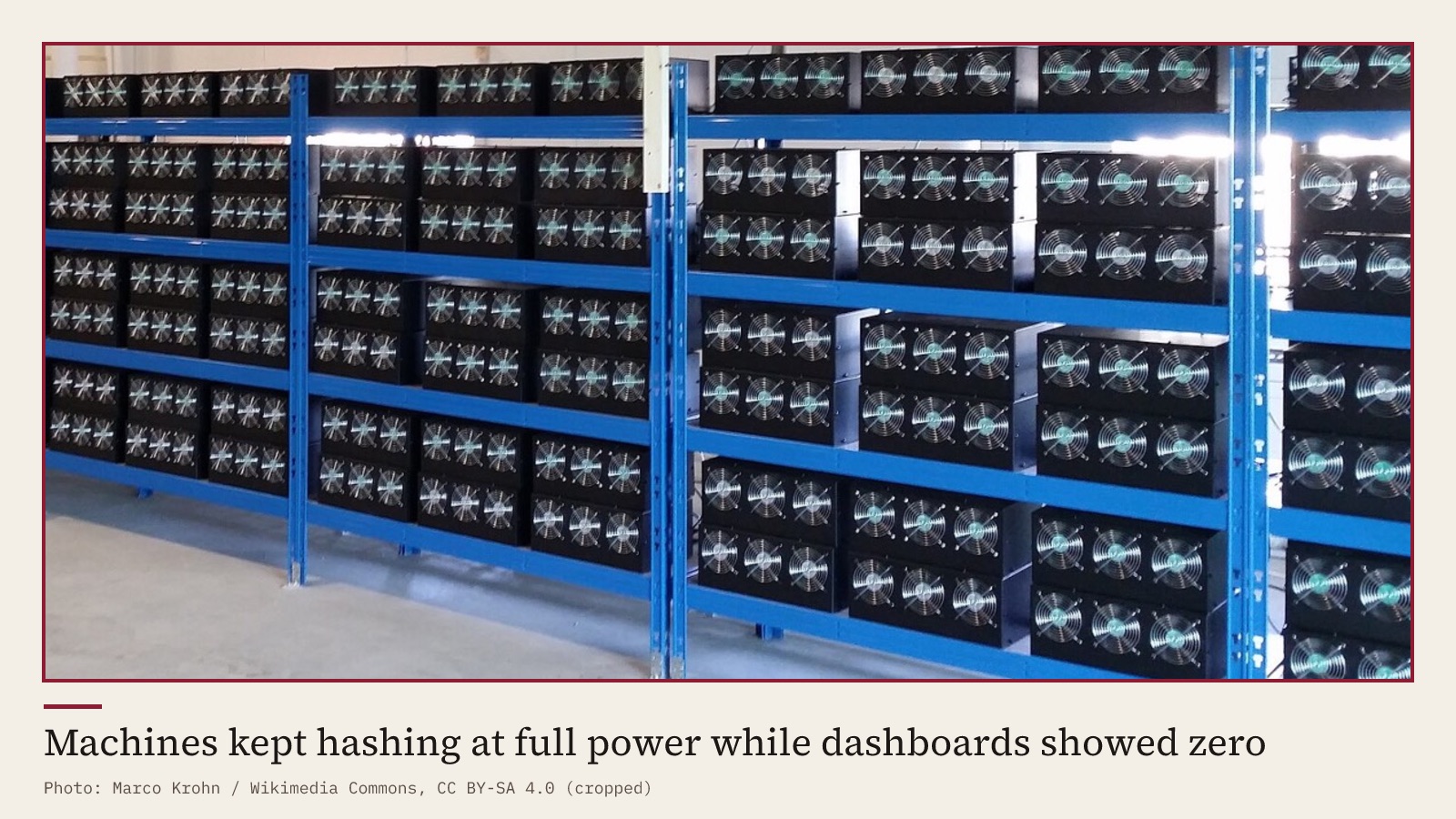
From the miner's side, the machines look healthy. Braiins said affected machines kept hashing at full power while pool dashboards showed zero hashrate. A site operator watching fans, power draw and temperatures would see nothing wrong. Only the pool view reveals the loss, and only if someone is looking.
Braiins traced early episodes in Latin America, mostly Brazil and Argentina, from early November. A bigger wave on Nov. 20 hit mostly European miners. A single burst took anywhere from 0.6 to 1.9 exahashes of computing power each second. Braiins said the stolen share of hashrate rose more than tenfold over a fortnight and described the pattern as the attacker testing the waters.
How Stratum V2 and TLS close the gap
The fix is to make the miner verify who it is talking to. Braiins has pointed to this exact attack since 2020 when urging miners onto the encrypted Stratum V2 protocol. Encryption hides the job and share traffic from anyone on the path. Authentication is the bigger part: the miner checks a cryptographic identity for the pool, so an impostor reached through a hijacked route cannot pass as the real server, even if it receives the connection.
Stratum V1 wrapped in TLS with certificate verification reaches a similar result for the identity check. The miner refuses a server that cannot prove it holds the pool's certificate. The key word is verification. TLS without certificate checks would encrypt the link but still accept the impostor.
This is why our own analysis treats the incident as a protocol question rather than a one-off breach. BGP route validation by network operators helps, but miners do not control it. Authentication inside the mining protocol is the layer miners can change themselves.
Who is affected
Any miner still on plain Stratum V1 is exposed, whichever pool it uses. Braiins put it bluntly: a miner on plain Stratum V1 "is a target, on any pool." Pools are affected too, because the stolen shares never reach them. Network operators matter because unvalidated routes are what let the redirect spread.
The risk is old. Dell SecureWorks documented the same routing trick in 2014, when it took roughly $83,000 in mining rewards. Decrypt noted that the industry long treated the threat as rare enough to accept, but two firms have now flagged live attacks within weeks.
Status and next steps
Braiins advises miners to move to Stratum V2, or to run Stratum V1 inside TLS with certificate checks. It also recommends dropping plain-text backup connections. A fallback to an unprotected link would bring back the same trust gap. Finally, it asks miners to press network operators to validate routes. For miners that cannot upgrade their setup, Braiins has published a proxy tool at no cost.
Sources
- Decrypt, 25 Nov 2026
AI wrote this summary from the primary documents and reports cited above. It went live automatically after checks that figures match those sources and nothing is copied; there was no human review. It explains a protocol or rule change and is not investment advice.