News analysis ·
Optech #431: witness malleation and anti-exfil signing
Bitcoin Optech's Newsletter #431 recap flags a block processing stall and draft anti-exfil BIPs. We explain both mechanisms and who they affect.
Bitcoin Optech released a podcast episode on 2026-11-17 that walks through its Newsletter #431. The headline items are a way to stall block processing through witness malleation and a set of draft proposals for anti-exfil signing. This article explains what each idea means at the protocol level and which parts of the Bitcoin stack they touch.
The change in one paragraph
Optech tracks Bitcoin development in a newsletter and podcast. In this recap, hosts Mark Erhardt, Gustavo Flores Echaiz and Mike Schmidt were joined by Antoine Poinsot. The episode opened with a news item about a stall in block processing that can be triggered through witness malleation. A second news item covered draft Bitcoin Improvement Proposals, or BIPs, that describe anti-exfil signing. Neither item is a finished rule change. One is a node robustness issue; the other is a proposed standard for how wallets and signing devices talk to each other.
Under the hood: what witness malleation means
Since the SegWit soft fork, the signature data that unlocks coins sits in a separate part of a transaction called the witness. The transaction ID does not cover the witness, which fixed an older problem where third parties could change an ID before confirmation. The witness can still be altered in some cases without making the transaction invalid. That is what malleation means: same spend, slightly different bytes.
A full node must check every block it receives. In general terms, altered witness data is a way to make a node handle the same block differently from what it expects. Optech's recap describes the outcome as a stall in block processing. The episode summary does not give technical details of the trigger, so we do not describe one here. What matters for readers is the category: this is about how quickly and reliably nodes accept valid blocks, not about who owns which coins.
- Transaction ID: a fingerprint of the spend that excludes the witness.
- Witness: signatures and scripts that prove the spender is allowed to spend.
- Block processing: the node's job of downloading, checking and connecting each new block.
- Stall: a delay that holds back a node from moving to the next block.
Under the hood: what anti-exfil signing protects against
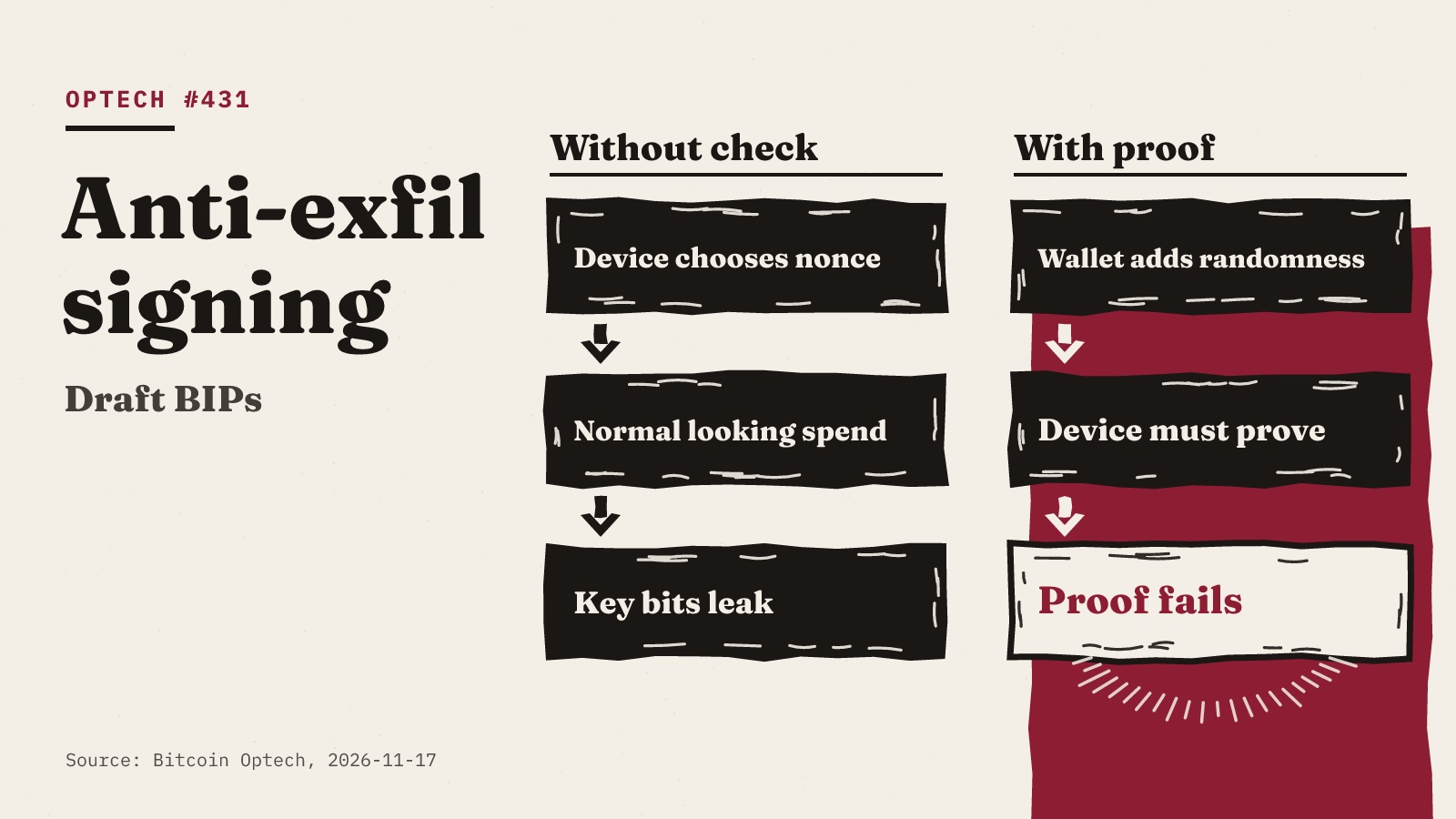
Every Bitcoin signature uses a secret random value called a nonce. If a signing device chooses that nonce badly, or chooses it on purpose to hide information, the signatures it produces can leak bits of the private key over time. A tampered hardware wallet could do this quietly, and the user would see normal looking transactions.
Anti-exfil signing adds a check. The computer or phone that asks for a signature contributes its own randomness, and the device must prove it mixed that randomness into the nonce. If the device tries to steer the nonce, the proof fails. The draft BIPs aim to write this exchange down as a shared standard, so different wallets and devices can support it the same way.
How to read an Optech issue
An Optech newsletter is not a list of decisions. It sorts work into news, releases and notable code changes, and each bucket carries a different weight. News items are often research or disclosures still under discussion. Releases are software that operators can install. Code changes are merged pull requests in a specific project.
Issue #431 shows all three. Besides the headline items, it notes that the genesis block for testnet5, a new Bitcoin test network, is set to be mined, and that developers kept comparing statistics on how well nodes rebuild blocks from compact block relay. On the release side it lists LDK v0.3-rc4, LDK v0.2.8 and LND v0.21.8-beta, all Lightning software. The rc in a version name marks a release candidate, meant for testing before a final release. Under code changes it names Bitcoin Core #36142, BIP repository edits #2251, #2347 and #2342, Core Lightning #9610, LDK #5507 and LND pull requests #11492, #11479, #11340, #11480 and #11481. A useful habit is to ask of each item: is it a proposal, a test, or shipped code?
Who is affected
The witness malleation item is most relevant to node operators and the developers of node software, because block processing is the node's core job. Optech's episode summary names no specific group, so this is our reading of the category, not Optech's statement.
Anti-exfil signing mostly concerns people who keep coins on hardware signing devices, and the teams that build those devices and the wallets that drive them. Ordinary users would only notice it as a feature their wallet supports or does not. Lightning node operators are the audience for the LDK and LND releases, and testnet5 is aimed at developers who need a place to try software without real money.
Status and next steps
The anti-exfil documents are drafts, so their wording can still change before any wallet adopts them. The testnet5 genesis block is described as about to be mined, not yet live. Optech has not posted a written transcript of the episode and marks it as coming soon, so fuller technical detail on the stall may appear there. Optech publishes this material under a Creative Commons CC BY-SA 2.0 licence.
Sources
- Bitcoin Optech, 17 Nov 2026
AI wrote this summary from the primary documents and reports cited above. It went live automatically after checks that figures match those sources and nothing is copied; there was no human review. It explains a protocol or rule change and is not investment advice.