News analysis ·
Moody's ratings over CCIP: how cross-chain data moves
Moody's and Chainlink tested sending credit ratings to several blockchains via CCIP. How the messaging layer works, and what a testnet run leaves open.
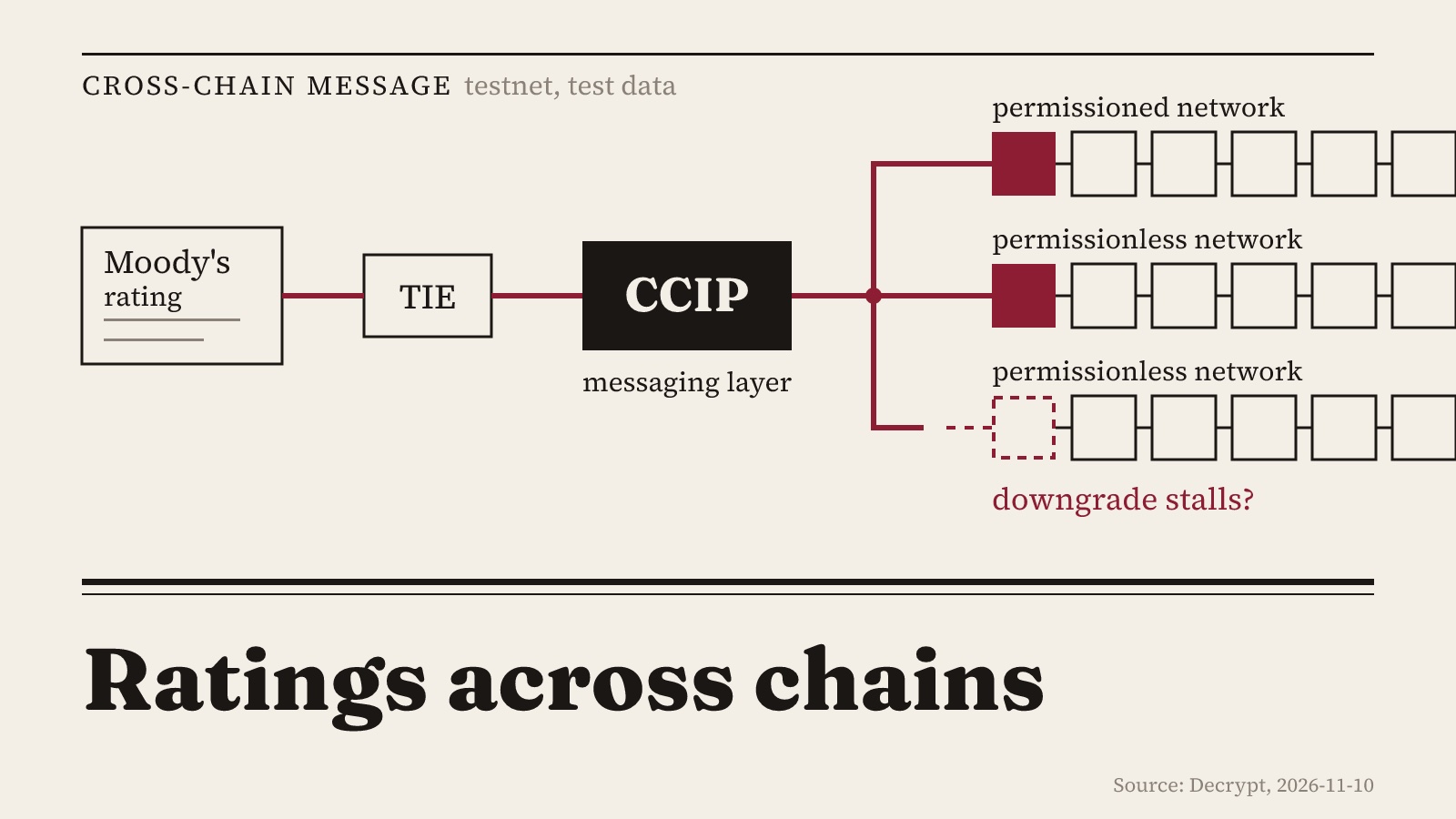
Moody's Ratings and Chainlink have finished a pilot that pushed credit ratings to several blockchains at the same time, Decrypt reported on 2026-11-10. The delivery ran over CCIP, Chainlink's Cross-Chain Interoperability Protocol, and it stayed on a testnet. This article looks at how one data feed can be fanned out across chains, what the messaging layer has to get right, and what the pilot did not test.
The change in one paragraph
Until now, Moody's has placed rating data on blockchains one network at a time. According to Decrypt, the firm first put its Ratings Token Integration Engine, or TIE, on the institutional Canton Network earlier this year, then extended it to Solana, which made its ratings machine-readable on a public chain. The new pilot changes the shape of that delivery. Instead of a separate integration per chain, TIE handed the ratings to a single interoperable layer, CCIP, which sent them out to permissioned and permissionless networks at once. The two companies said Moody's usual publication and governance steps were left as they were.
Under the hood: how a cross-chain message carries a rating
A blockchain cannot read another blockchain directly. Each chain only knows its own state. To move a piece of data from one network to another, something outside both chains has to watch the first one, confirm what happened there, and write a matching record on the second one. That something is a cross-chain messaging protocol. CCIP is Chainlink's version of it.
In general terms, the moving parts of a set-up like this pilot look roughly like this:
- The publisher: Moody's issues a rating through its own process, then TIE turns it into data a smart contract can read.
- The messaging layer: CCIP takes that data and packages it as a message addressed to each target chain.
- The relay and checks: a messaging protocol needs some party, or group of parties, to observe the message and vouch for it before it is accepted elsewhere. Decrypt's report, as summarised in the fact sheet, does not say how CCIP does this in the pilot.
- The receiving contracts: on each destination chain, a contract verifies the attestation and stores the rating where other applications can query it.
- The audience: on a permissionless chain anyone can read the stored value; on a permissioned network only approved participants can.
The hard part is not sending a rating once. It is keeping every copy in step. A credit rating is a living value: it can be upgraded, downgraded or withdrawn. If a downgrade reaches one chain but stalls on another, two holders of the same tokenized bond could see different ratings for the same issuer. That is why the messaging layer becomes part of the trust model. Users must trust Moody's for the rating itself, and the delivery network for arriving intact, on time and on every chain. Johann Eid, who serves as Chainlink Labs' chief business officer, put the goal this way: "As more financial assets move onchain, credit intelligence has to move with them, across chains and through every rating change".
Why one layer instead of many integrations
The stated reasoning is about where tokenized assets live. As bonds, funds and other instruments are issued as tokens, holders will want rating data on whichever network their tokens sit, Decrypt reported. Fabian Astic, who leads digital economy work globally at Moody's, said tokenized finance probably will not settle on one chain, platform or market infrastructure.
From a protocol point of view, a shared messaging layer trades one kind of complexity for another. Maintaining a custom link to every chain multiplies code and audit work. Routing everything through one protocol reduces that, but it concentrates risk: a fault in the shared layer could affect every destination at once. That is why the relay and verification steps matter as much as the data.
Who is affected
According to Decrypt, Moody's has issued ratings or assessments on more than 70 digital issuances from January 2017 to October 2026, among them tokenized funds and digital bonds. Issuers of such instruments, and the investors who hold them, are the main audience. Developers building lending or settlement apps could, in principle, read a rating straight from a contract on their own chain rather than from an off-chain feed.
For Chainlink, the pilot is another use case for CCIP. Decrypt noted that Chainlink recently released an upgraded version of the protocol and says it has secured tens of billions of dollars in value moving between chains. Eid described the pilot as a foundational piece for institutions that want to adopt tokenization at scale.
Status and next steps
This is a proof of concept, not a product. The whole run took place on a testnet with representative test data. No real rating actions were posted onchain, and nothing was disseminated live. The companies said the design can accommodate future rating updates under appropriate governance, but the pilot did not show those updates flowing in production.
Practical questions remain open, and the report does not answer them. How fast does a downgrade reach every chain? What happens if one destination is congested or paused? Test data on a testnet is a weak guide to live conditions.
Sources
- Decrypt, 10 Nov 2026
AI wrote this summary from the primary documents and reports cited above. It went live automatically after checks that figures match those sources and nothing is copied; there was no human review. It explains a protocol or rule change and is not investment advice.