News analysis ·
Ethereum upgrade Hegotá: FOCIL and frame transactions
Hegotá, the Ethereum upgrade after Glamsterdam, lists FOCIL and frame transactions. How each works, who it affects and what is still undecided.
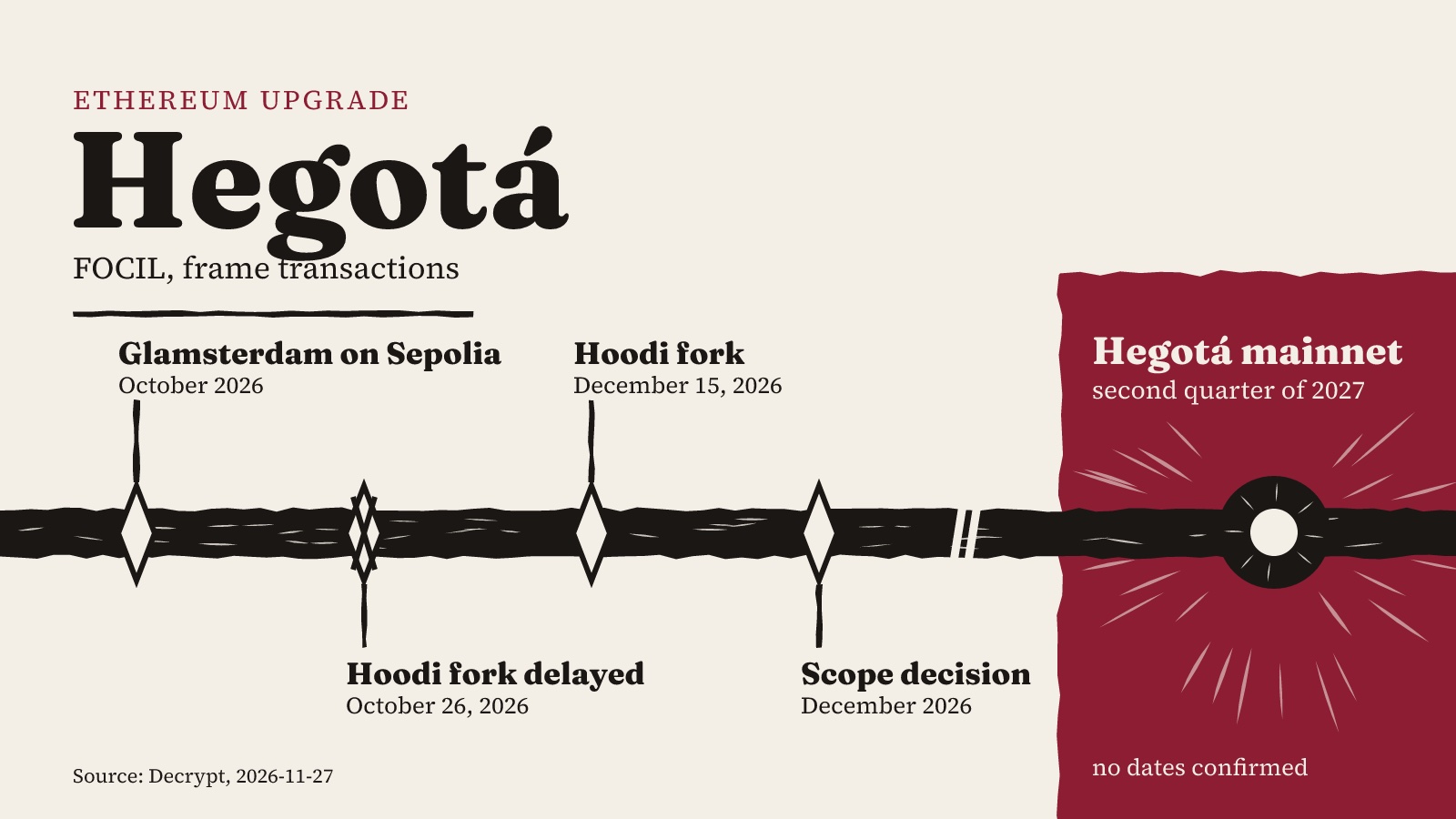
Ethereum's next named upgrade after Glamsterdam is Hegotá, and so far it carries two scheduled changes: inclusion lists that limit censorship and a new transaction type that lets each account set its own validity rules. Decrypt laid out the plan in an updated roadmap explainer. This article looks at how both mechanisms work, who would feel them, and which parts of the fork are still open.
The change in one paragraph
Hegotá would change two basic things about Ethereum. First, who decides which transactions enter a block: today that choice rests with whoever builds the block, and under Hegotá a group of validators could force certain transactions in. Second, what makes a transaction valid: today every ordinary account proves itself with the same fixed signature scheme, and under Hegotá an account could define its own rules. The name joins Bogotá, the execution-layer half named after a past Devcon city, with Heze, the consensus-layer half named after a star.
What is an Ethereum upgrade, and when is Hegotá?
An Ethereum upgrade is a hard fork: a coordinated rule change that every node must adopt at the same moment, because blocks made under the new rules are not valid under the old ones. Ethereum does not ship one big release. According to Decrypt, the community aims for about two major upgrades a year, when research and testing are ready.
For Hegotá, ethereum.org's October 2026 update expected a Sepolia testnet fork first and then mainnet in the second quarter of 2027. Decrypt stressed that none of these dates had been confirmed.
Under the hood: inclusion lists and frame transactions
The headline item is Fork-choice Enforced Inclusion Lists, or FOCIL, numbered EIP-7805. Its goal is stronger censorship resistance. Today, whoever builds a block can leave a valid transaction out, and the protocol does not stop that.
FOCIL adds a second set of eyes. A committee of validators each proposes a list of transactions it sees waiting. The block builder must include those transactions. The key word is fork-choice: the rule is enforced through the logic validators use to decide which block to follow. One party alone can no longer keep a valid transaction out.
The second change is Frame Transactions, EIP-8141. Today an ordinary Ethereum account is controlled by one private key and one signature scheme baked into the protocol. Frame transactions would let each account state its own test for a valid transaction.
- Before FOCIL: the block builder alone chooses what goes in.
- After FOCIL: validator lists set transactions the builder must include.
- Before EIP-8141: one fixed signature scheme for every ordinary account.
- After EIP-8141: each account defines its own validity rules.
Per Decrypt, that flexibility would move social recovery, spending caps, multi-approval and gas sponsorship into the protocol itself. It would also let accounts pick signature schemes built to withstand quantum computers.
Who is affected
Users would mainly notice FOCIL as a protection they rarely see: a valid transaction that pays its fee should not be left waiting because one builder refuses it. Frame transactions would be more visible. Per Decrypt, features such as social recovery, spending caps and gas sponsorship would live in the protocol itself.
Block builders lose some freedom over block contents. Validators on the committee would propose the transaction lists. Node operators and stakers must update their client software for each fork, Decrypt noted, while people who simply hold ETH need take no action.
Status and what is still undecided
Hegotá's scope is not fixed. Beyond the two scheduled changes, dozens of other proposals are under consideration and none are settled. During November 2026, a group of developers made the case for cutting FOCIL, so that effort could shift toward defending Ethereum from future quantum computers. That sets up a real trade-off between censorship resistance now and quantum safety later. A decision on the full scope is expected in December 2026, and the Forkcast tracker follows each proposal.
Hegotá is planned to follow Glamsterdam, which focuses on scaling the base layer. Glamsterdam reached Sepolia in October 2026, but its Hoodi testnet fork, set for October 26, 2026, was delayed after ChainSecurity warned that its gas changes could weaken safeguards in existing contracts. Developers moved the Hoodi fork to December 15, 2026 and kept the gas changes as they were. As of November 2026 Glamsterdam had no mainnet date, and Decrypt cautioned that upgrade names and scopes can still change before a fork ships.
Sources
- Decrypt, 27 Nov 2026
AI wrote this summary from the primary documents and reports cited above. It went live automatically after checks that figures match those sources and nothing is copied; there was no human review. It explains a protocol or rule change and is not investment advice.