News analysis ·
EIP-8288 and leanPCS: a quantum-safe Ethereum upgrade
Vitalik Buterin now backs leanPCS for EIP-8288. We explain how proof aggregation could fit bulky quantum-safe signatures into Ethereum blocks.
Ethereum co-founder Vitalik Buterin has come out strongly in favour of leanPCS, a way to build the draft proposal EIP-8288, Decrypt reported. The idea is to squeeze large quantum-safe signatures and proofs into one compact proof before they reach a block. This article looks at why that squeeze is needed, how the aggregation works, and what it would change for users and node operators.
The change in one paragraph
Today, Ethereum accounts are protected by elliptic curve cryptography. Quantum computers are expected to break that kind of cryptography eventually. The replacements are much bigger. According to Buterin, a signature that takes 65 bytes today would need between 1 and 6 kilobytes, and a zero-knowledge proof of a few hundred bytes would swell to around 128 kilobytes. "This is unsustainable to put on chain," Buterin wrote, as quoted by Decrypt. EIP-8288, a draft he co-wrote with developer Thomas Coratger in June, answers this by aggregating those signatures and proofs before block inclusion, so only short claims are stored onchain.
In a long post on X on November 16, 2026, Buterin said his view of leanPCS had moved over recent weeks from scepticism to strong support.
Under the hood: how proof aggregation works
A STARK is a type of zero-knowledge proof: a short piece of data that convinces anyone a computation was done correctly, without redoing it. Its core mathematical building block is a polynomial commitment scheme, or PCS. That is where leanPCS gets its name.
EIP-8288 uses STARKs to fold many large items into one small one. The moving parts, as Decrypt described them:
- Users publish their quantum-safe signatures or proofs to the network, not straight into a block.
- Nodes take everything they have seen and bundle it into a single STARK that attests all of it is valid.
- Those bundles are combined again and again, until one master proof covers everything in the block.
- The block stores only short claims. The full signatures and proofs never need to live onchain.
The trick is that checking a proof about many signatures costs far less space than storing the signatures themselves. The bulky data does its job off the chain, and the chain keeps a compact receipt that the job was done correctly.
Three routes, and why Buterin prefers leanPCS
Buterin set out different ways to build the system, depending on what users are allowed to submit.
leanSPHINCS is the narrowest. It supports only one kind of hash-based quantum-safe signature. Each signature would cost users a small amount of gas, but it can do nothing else.
leanSTARK is the broadest. It would accept any signature scheme, privacy protocols and hidden multisig logic. The catch is that the community would first have to settle which language user programs are written in. Buterin described that choice as the first major step of Ethereum going past the EVM, and said it will likely take time.
leanPCS sits between them. It offers the same generality as leanSTARK but requires far fewer design decisions, so Buterin said it could be built quickly, with leanSTARK added later. He argued this route could reach what he calls the cryptographic proof singularity sooner than developers expected.
The cost picture: what the gas numbers show
A gas fee is what users pay for the computation and storage their transaction uses on Ethereum. Signature checks are part of that bill, so the size of quantum-safe signatures matters directly to users.
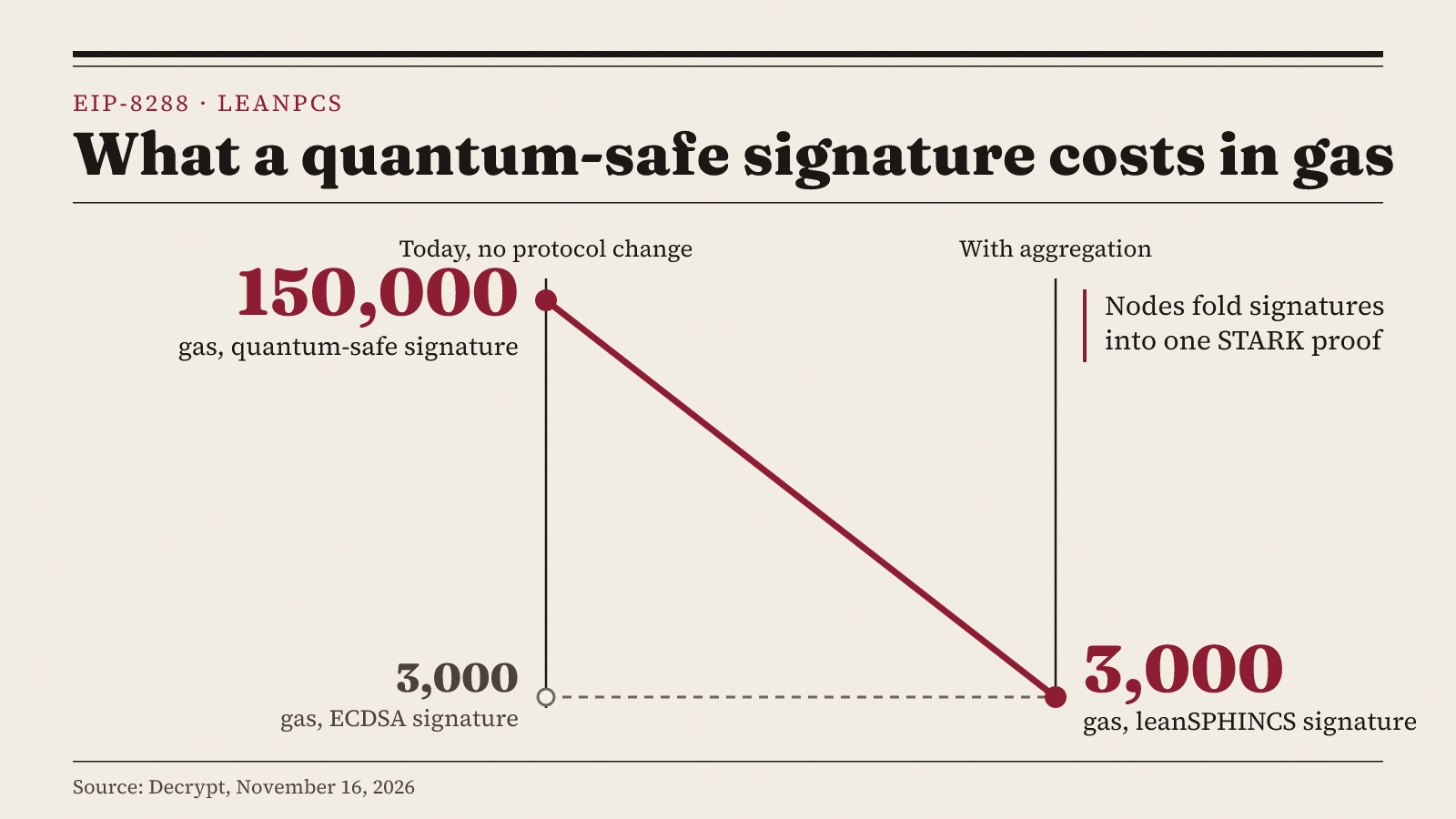
The numbers in the research show why aggregation is the point of the proposal. A June write-up on the Ethereum Research forum about SPHINCS-, a hash-based signature family, showed that checking a quantum-safe signature that follows the standards is already possible on Ethereum for about 150,000 gas, with no protocol change. An ECDSA signature, the kind used today, costs about 3,000 gas, according to an earlier Buterin estimate. With aggregation built into the protocol, checking a leanSPHINCS signature would take about 3,000 gas, the same post says.
Read together, these figures describe the trade. Without a protocol change, moving to quantum-safe signatures is possible but expensive per transaction. With EIP-8288, the heavy verification work moves to the nodes that build aggregate proofs, and the per-signature cost to users falls back to roughly the level they pay today. The trade is that the heavy work moves to nodes, so the design depends on STARKs and hash-based signatures being sound.
Who is affected
Users would eventually sign with larger quantum-safe keys, ideally without higher fees. Wallet and smart contract developers would need to support new signature types, and under the more general routes could use privacy features or hidden multisig logic. Node operators would take on the job of building and combining proofs. Validators are in scope as well: developers have separately proposed reworking the staking deposit contract to accept post-quantum validator keys.
Status and next steps
EIP-8288 is still a draft. No route has been adopted, and leanSTARK depends on a language decision that has not been made. The work has institutional backing: since January, the Ethereum Foundation has run its own team focused on post-quantum security. Buterin's endorsement is the view of one of the proposal's authors, not an adoption decision.
Sources
- Decrypt, 16 Nov 2026
AI wrote this summary from the primary documents and reports cited above. It went live automatically after checks that figures match those sources and nothing is copied; there was no human review. It explains a protocol or rule change and is not investment advice.