News analysis ·
EIP-8037 locked: the new gas fee for Ethereum state
Ethereum developers kept EIP-8037 unchanged and set Hoodi for December 15. How the state gas repricing works and which contracts must check their assumptions.
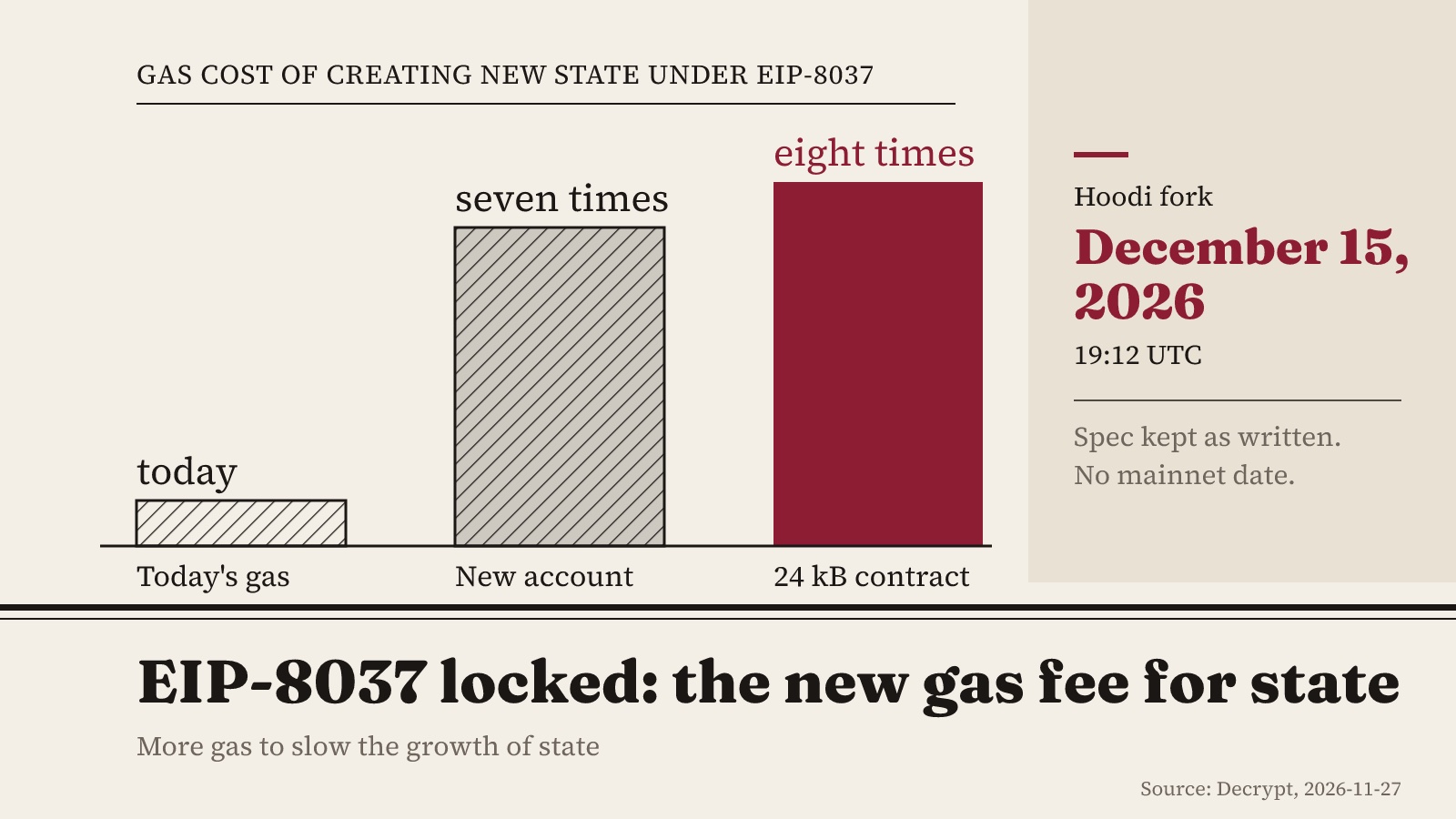
Ethereum core developers have decided to keep EIP-8037, the disputed gas repricing inside Glamsterdam, exactly as written, and have scheduled the Hoodi testnet fork for December 15, 2026, according to Decrypt and Unchained. This article looks at what the repricing changes inside the gas meter, why some existing smart contracts could be caught out, and what still has to happen before mainnet.
The change in one paragraph
EIP-8037 makes it more expensive, in gas, to create new things on Ethereum: new accounts, new storage entries and new contract code. The goal is to slow the growth of state, the data every node has to keep, as block gas limits rise. On Thursday's All Core Devs Consensus (ACDC) meeting, developers reached rough consensus to keep the specification unchanged rather than rewrite it or delay again. Decrypt reported that Hoodi will activate at 19:12 UTC at epoch 143,616, with December 15 chosen over December 16. No mainnet date has been set.
What is a gas fee, and what does EIP-8037 reprice?
A gas fee is what a user pays for the work a transaction asks the network to do. Each operation has a gas cost, and the total gas used, multiplied by the price per unit of gas, sets the fee. EIP-8037 does not change that formula. It changes the gas cost attached to operations that leave permanent data behind.
According to Decrypt, creating a new account would cost roughly seven times today's gas, and deploying a 24 kB contract roughly eight times as much. The authors say this aims to keep new state near 120 GiB per year, assuming a block gas limit of 150 million.
Under the hood: a second meter for state
The larger technical shift is not the price but the accounting. Today, the gas a contract sees is one running balance that only goes down as code runs. EIP-8037 charges state creation on a separate meter from ordinary computation. Decrypt explained that this lets gas flow back to a contract during execution, which some existing security checks do not expect.
- Before: gas remaining falls steadily, so a contract can read it once and treat that number as an upper bound for everything that follows.
- After: state costs are tracked apart from computation, and gas can be returned mid-execution, so the remaining balance can rise as well as fall.
- The GAS opcode, which reports gas remaining, becomes a weaker signal, and some developers on the call questioned how useful it still is.
- Any contract logic that assumes a fixed or shrinking budget, for example a guard that limits what a callee can do by capping its gas, needs to be re-checked.
This is why the Hoodi fork was first postponed from October 26. Security firm ChainSecurity warned that the gas changes could weaken protections in deployed contracts and pointed to 13 real-world examples. The lesson for contract authors is general: gas is a pricing tool, not a security boundary, and code that leans on exact gas amounts inherits every future repricing.
Who is affected
Application developers carry most of the work. Unchained cited Austin Griffith, who said on a Nov. 12 episode of its podcast that builders were pushing back hard on the repricing. Teams that create many accounts or deploy contracts often will pay more gas, and teams whose safety checks rely on gas readings will need to review them.
Client teams also had to accept trade-offs. Unchained reported that Ethlabs' Ansgar Dietrichs, who led the execution layer part of the call, polled every execution client and warned that indecision would push the upgrade into next year. None vetoed. Besu's Luis Pinto said his late idea to settle gas refunds only at the end of a transaction fell short and abstained. Erigon's Andrew Ashikhmin called the change possibly the lesser evil despite broken invariants, while his colleague Pawel Bylica voiced doubt. Reth's Dragan Rakita said a delay of months was too long.
On the consensus side, teams chose PR 5770, which verifies a block hash by importing the RLP encoding, over PR 5820, a cleaner change to consensus rules that would have pushed back the testnet timeline. Ben Edgington, who hosted the call, said any delay from that side now needed a very high bar, meaning only security-critical fixes. A number of teams liked 5820 better, yet no team stood in the way of 5770. "Nobody's particularly happy, but we need to take a pragmatic view," Edgington said, according to Unchained.
Ethereum upgrade date: status and next steps
Glamsterdam has run on the Sepolia testnet since October, with a gas limit over three times the mainnet level. Hoodi follows on December 15. Dietrichs said that running Hoodi on the unchanged spec after Sepolia effectively commits mainnet to the same design, though the timing stays open.
Decrypt reported that execution and consensus client teams are expected to publish releases for the fork early next week. Separately, whether FOCIL, a design meant to make transaction censorship harder, stays a headline feature of the next upgrade, Hegota, was deferred to the following ACDC call, expected around Dec. 10. The main risk to watch is contract breakage: projects that depend on gas readings have a testnet window to find problems before any mainnet date is chosen.
Sources
AI wrote this summary from the primary documents and reports cited above. It went live automatically after checks that figures match those sources and nothing is copied; there was no human review. It explains a protocol or rule change and is not investment advice.