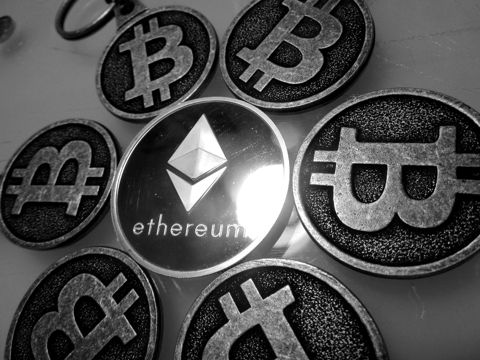
Ether (ETH) and the Ethereum network
Ethereum's native currency, set out as a fact sheet: who started the network, how ETH is issued and burned, and the upgrades that changed it.

On this page
- Ether (ETH) is the native currency of Ethereum, a programmable blockchain that launched in July 2015.[1]
- Ethereum switched from proof-of-work to proof-of-stake in The Merge on 15 September 2022.[4]
- ETH has no fixed cap: new ETH goes to validators, while the base fee of every transaction is burned.[2]
- Running a validator takes a 32 ETH deposit, and misbehaving validators can have part of that stake destroyed.[6]
- The SEC's March 2026 interpretive release names ETH as an example of a digital commodity.[12]
What is ether and who created Ethereum?
Ethereum is a decentralized blockchain and software platform, and ether (ETH) is the currency that powers it.[1] ethereum.org says Vitalik Buterin proposed Ethereum in a 2013 white paper, Gavin Wood and Joseph Lubin had joined by 2014, and the network launched in July 2015.[1]
The white paper's central idea was a blockchain with a built-in programming language so that anyone could write smart contracts with their own rules. ethereum.org keeps it as a historical document and notes it no longer describes Ethereum as it works today.[3]
No single company controls the network. The Ethereum Foundation supports development but does not govern it; changes go through Ethereum Improvement Proposals (EIPs) and community agreement.[1] For the concept itself, read What is Ethereum?
How does the Ethereum network work today?
Since The Merge, Ethereum runs on proof-of-stake. Time is divided into 12-second slots, grouped into 32-slot epochs.[6] In each slot one validator is chosen at random to propose a block, and committees of other validators vote on it.[6] When checkpoints are backed by at least two-thirds of all staked ETH, they become finalized,[6] and a finalized transaction is extremely costly to reverse.[10]
To become a validator you deposit 32 ETH into the deposit contract and run three pieces of software.[6] Validators that go offline lose rewards; those that sign conflicting messages can be slashed, losing part of their stake.[6] Our staking guide compares solo staking, pools and exchanges.
How is ETH created and destroyed?
ETH supply moves in two directions. New ETH is issued to validators as rewards, and part of every transaction fee is burned, which removes that ETH from circulation.[2] The burn dates from the London upgrade in August 2021, which introduced EIP-1559.[5]
| Flow | Who gets it | Effect on supply |
|---|---|---|
| Validator rewards | Validators that propose and attest to blocks | Adds new ETH |
| Base fee | Nobody: it is burned | Removes ETH |
| Priority fee (tip) | The validator that includes the transaction | No change |
Whether total supply rises or falls in a given period depends on how much is issued versus burned, so ETH has no fixed cap like Bitcoin's 21 million.[1]
What is ether used for?
- Paying fees. Every Ethereum transaction requires a fee paid in ETH.[2]
- Securing the network. Validators stake ETH as collateral and earn ETH rewards.[1]
- Inside applications. Many apps expect the ERC-20 token format, so ETH is often wrapped into WETH, an ERC-20 version of the same asset.[2]
- On layer 2 networks. Since the Dencun upgrade in March 2024, rollups can post cheaper data to Ethereum as blobs.[11] See rollups explained.
What are the key dates in Ethereum's history?
Ethereum changes through named upgrades, or forks. The dates below come from ethereum.org.
| Date | Event |
|---|---|
| 2013 | Vitalik Buterin proposes Ethereum in a white paper[1] |
| July 2015 | Network launches with ether as its currency[1] |
| 20 July 2016 | DAO fork at block 1,920,000 after an attack drained over 3.6 million ETH; Ethereum Classic continues the old chain[5] |
| 1 December 2020 | Beacon Chain (proof-of-stake chain) launches in parallel[4] |
| 5 August 2021 | London upgrade introduces EIP-1559 and the base-fee burn[5] |
| 15 September 2022 | The Merge: proof-of-work replaced by proof-of-stake[4] |
| 12 April 2023 | Shanghai/Capella enables staking withdrawals[7] |
| March 2024 | Dencun upgrade adds blob data for rollups (EIP-4844)[11] |
What are the specific risks of holding ether?
- Smart contract risk. Ethereum's own history includes the DAO attack, which drained over 3.6 million ETH from one contract in 2016.[5] Code you interact with can contain bugs.
- Staking penalties. Validators lose rewards when offline, and a slashing penalty can range from under 0.1% of stake to 100%, depending on how many validators are slashed at once.[6]
- Pooled and exchange staking. ethereum.org lists smart contract, counterparty and centralization risks for pools and exchanges that stake on your behalf.[8]
- Finality. Once a transaction is finalized, reversing it is extremely costly, so a mistaken transfer is very hard to undo.[10]
- Custody. With self-custody you may permanently lose access if your wallet is lost or hacked; with a custodian you carry its hack or bankruptcy risk.[13]
What mistakes do beginners make with ether?
- Thinking The Merge cut fees. ethereum.org says it changed the consensus mechanism, not network capacity, and was not meant to lower gas fees.[4]
- Believing you need 32 ETH to run a node. Only validators stake; anyone can run a node without a deposit.[4] Read what a node is.
- Holding only tokens and no ETH. Every transaction needs ETH for the fee, so a wallet with tokens but no ETH cannot move them.[2]
- Treating WETH and ETH as different assets. WETH is a wrapped, ERC-20 form of ETH used by apps.[2]
Questions readers ask
Is there a maximum supply of ether?
No fixed cap. ethereum.org describes ETH supply as dynamic: issuance to validators adds ETH and burned fees remove it.[2]
What is the difference between Ethereum and ether?
Ethereum is the network and software platform; ether (ETH) is its native currency, used for fees and staking.[1]
When could stakers withdraw their ETH?
Withdrawals were enabled with the Shanghai/Capella upgrade on 12 April 2023,[7] not at The Merge.[4] See liquid staking explained for staking through tokens.
Is ETH a security in the US?
The SEC's March 2026 interpretive release, joined by the CFTC, lists ETH as an example of a digital commodity.[12] Staking products offered by third parties can raise separate questions; see SEC vs CFTC.
Ether is the fuel and the collateral of Ethereum: it pays every fee and secures the chain through staking.[1] Its supply is set by a running balance of issuance and burning rather than a fixed cap.[2] Before holding or staking it, understand the contract, staking and custody risks above.
Sources
- ethereum.org, What is Ethereum? (2025)Primary source
- ethereum.org, What is ether (ETH)? (2025)Primary source
- ethereum.org, Ethereum Whitepaper (2025)Primary source
- ethereum.org, The Merge (2025)Primary source
- ethereum.org, History of Ethereum forks (2026)Primary source
- ethereum.org, Proof-of-stake (PoS) (2025)Primary source
- ethereum.org, Staking withdrawals (2025)Primary source
- ethereum.org, Ethereum staking (2025)Primary source
- ethereum.org, Gas and fees (2025)Primary source
- ethereum.org, Transactions (2025)Primary source
- ethereum.org, Danksharding (2026)Primary source
- US Securities and Exchange Commission, SEC Clarifies the Application of Federal Securities Laws to Crypto Assets (2026-30) (2026)Primary source
- US Securities and Exchange Commission (Investor.gov), Crypto Asset Custody Basics for Retail Investors (2025)Primary source
Educational content only — not financial, investment, legal or tax advice. Crypto-assets are high-risk and you could lose all the money you put in. Rules differ by country; check with your national regulator. See our risk disclosure and editorial policy.
Read next
- Crypto Basics · Beginner
What is Ethereum?
A blockchain that runs programs: ether, gas fees, smart contracts and what the Merge changed.
- Mining, Staking & Infrastructure · Beginner
Proof of work vs proof of stake
Two ways to pick who writes the next block — and what each one asks an attacker to put on the line.
- Mining, Staking & Infrastructure · Beginner
What is staking?
How locked-up coins secure proof-of-stake chains, the four ways to stake ETH, and what can go wrong.
- Glossary · Definition · Beginner
Gas fee
What you pay to get an Ethereum transaction processed, with the formula worked through.